AvenChat Gemma 4 Online
avenchat.comGemma 4 chat and guides
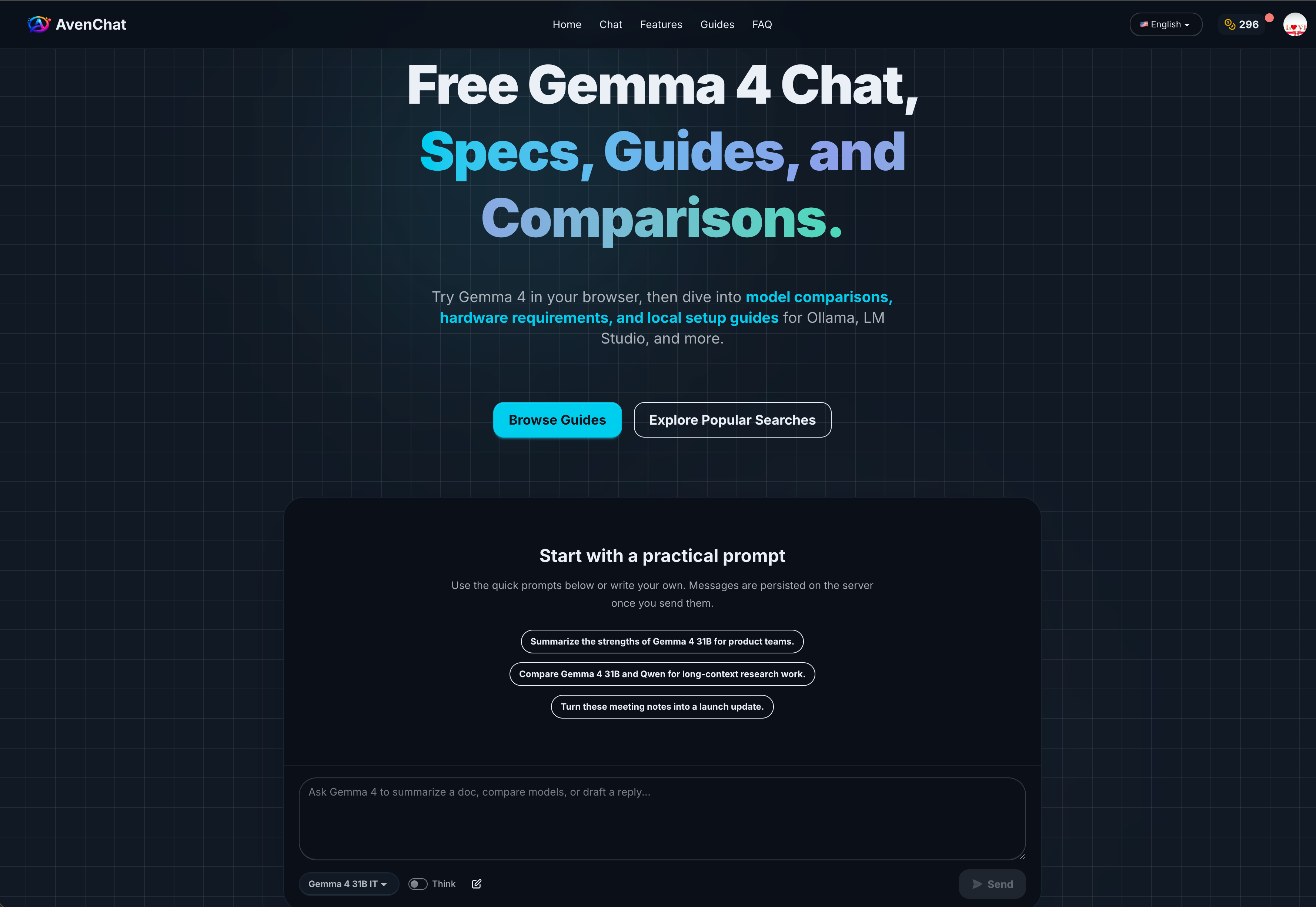
Test Gemma 4 prompts free in your browser, then follow guides for local setup with Ollama or LM Studio.
Overview
AvenChat is an independent third-party service built around Google's open-weight Gemma 4 model family. It offers a free browser-based chat to test prompts and outputs, plus updated guides covering model comparisons, hardware requirements, and local setup for runtimes like Ollama and LM Studio. It is for developers and teams evaluating Gemma 4 before self-hosting or integrating it.
How it works
AvenChat provides a free web chat for testing Gemma 4 prompts, summarizing documents, and comparing outputs before committing to a local setup. The site also hosts detailed guides on model selection, hardware requirements, and local deployment paths, with step-by-step walkthroughs for Ollama, LM Studio, llama.cpp, MLX, and Gemma.cpp. Users can start with the chat or jump straight to the guides based on their immediate needs.
Key capabilities
The site covers all five official Gemma 4 variants: E2B, E4B, 12B, 26B A4B, and 31B. It details context lengths from 128K to 256K, multimodal input support for images and video across all models, and native audio input on E2B, E4B, and 12B. Approximate Q4 memory guidance ranges from 2.9 GB for E2B to 17.5 GB for 31B, with 12B around 6.7 GB, helping users match models to their hardware.
Who it is for
AvenChat is for developers, AI enthusiasts, and teams evaluating Gemma 4 for self-hosting or product integration. It serves those comparing model sizes for quality, latency, and cost trade-offs, as well as users planning local inference with tools like Ollama or LM Studio. The guides also help decision-makers understand the Apache 2.0 license benefits and deployment flexibility before committing.
Pricing and limits
AvenChat is free to use, with no paid plans mentioned. The free web chat allows unlimited prompt testing in the browser, while the guides are openly accessible. The site is updated for Gemma 4 12B, ensuring the latest model information is available. Users can explore popular searches like Gemma 4 vs Qwen and hardware requirement tables without any cost.
Key features
Free web chat
Free browser-based chat to try Gemma 4 without setup.
Model comparisons
Updated comparisons of Gemma 4 12B, 26B A4B, 31B, and other variants.
Hardware requirement tables
Tables for approximate Q4 memory needs from 2.9 GB to 17.5 GB.
Local setup guides
Step-by-step guides for Ollama, LM Studio, llama.cpp, MLX, and Gemma.cpp.
Full model family coverage
Covers all official Gemma 4 sizes: E2B, E4B, 12B, 26B A4B, and 31B.
Use cases
Prompt testing
Evaluate Gemma 4 prompts and outputs in the browser before self-hosting.
Model selection
Compare E2B, E4B, 12B, 26B A4B, and 31B for quality, latency, and hardware needs.
Local deployment
Follow step-by-step guides to run Gemma 4 locally with Ollama, LM Studio, or llama.cpp.
Hardware planning
Check approximate Q4 memory requirements to match a model to your machine.
Pricing & limits
From the official site · checked 10/10/2026Frequently asked questions about AvenChat Gemma 4 Online
- What is AvenChat?
- AvenChat is a free browser-based chat service for trying Google's Gemma 4 model family, along with guides for model comparison, hardware requirements, and local setup.
- Is AvenChat free to use?
- Yes, AvenChat offers a free web chat to test Gemma 4 prompts and use cases before deciding on a local or hosted setup.
- Can I run Gemma 4 locally with AvenChat's help?
- AvenChat provides guides for running Gemma 4 locally with Ollama, LM Studio, llama.cpp, MLX, and Gemma.cpp.
- Which Gemma 4 models does AvenChat cover?
- The site covers all official Gemma 4 variants: E2B, E4B, 12B, 26B A4B, and 31B, with details on context length, multimodal support, and memory needs.
Related tools

GLM 5
Chat, code, generate images and videos with a 200K context frontier model.

GLM 5 - Free AI Chat, Image & Video Generator
Generate images, videos, and chat responses with the GLM 5.2 model in your browser.
Ptero
Chat with multiple AI models for free, with your conversations staying private in your browser.

Claude
Chat with an AI assistant that reads long documents, writes and edits text, and helps with code and research.

ChatGPT
Ask questions, draft text, analyze files and images, and write code in one chat on web, desktop, and mobile.